遠藤大使による主要英字紙への寄稿(天皇誕生日に際しての日本特集)
令和8年2月23日
2月23日、遠藤大使は、天皇誕生日を記念してフィリピン主要英字紙(オンラインを含む7媒体)が実施した日本特集に寄稿しました。
Threads that bind: On Japan and the Philippines’ enduring friendship
(Ambassador ENDO Kazuya's written contribution on the occasion of the 2026 Japan National Day)
Today, Japan commemorates the 66th birthday of His Imperial Majesty Naruhito. On this auspicious occasion, I am pleased to share in this celebration with our Filipino friends and the Japanese community in the Philippines.
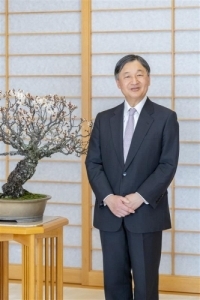
His Majesty the Emperor
© Imperial Household Agency of Japan
This year also marks a momentous milestone: the 70th Anniversary of Philippines-Japan Friendship, celebrated under the theme “Weaving the Future Together: Peace, Prosperity, Possibilities.” The symbolic anniversary logo, designed by Mr. Edmon Fuerte, a young artist from Baguio, beautifully combines Japan’s shimenawa rope with the Filipino abaca fiber. It reflects how our two nations have steadily woven beautiful threads of trust, partnership, and shared hope over seven decades.
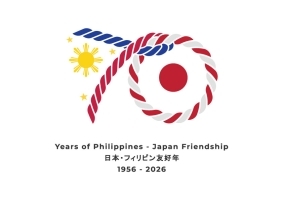
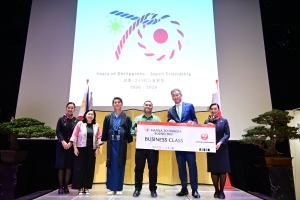
The 70th Philippines-Japan Friendship Logo designed by Mr. Edmon Fuerte, inspired by Japan’s shimenawa rope and the Philippines’ abaca fiber
Looking back to seven decades of trust
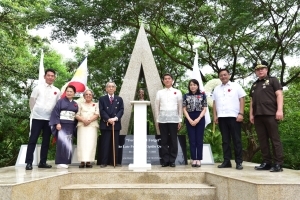
[L] Unveiling of the Memorial Monument for late President Elpidio Quirino, who granted amnesty to Japanese prisoners of war (POWs) in the Philippines in 1953
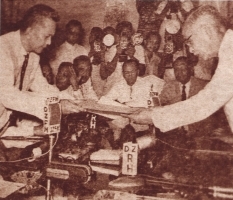
[R] Philippine Ambassador Felino Neri and Japanese State Minister TAKASAKI Tatsunosuke at the signing of Japan-Philippines Reparations Agreement, 9 May 1956 ©Manila Bulletin
Since Japan made its solemn pledge to peace and embarked on its postwar path as a peaceful nation, many predecessors on both sides made numerous contributions for these long-term efforts. A hopeful thread in our shared history can be found in President Elpidio Quirino’s pardon of Japanese prisoners in 1953. In 1956, the Japan–Philippines Reparations Agreement was signed — marking a foundational moment in our bilateral relationship.
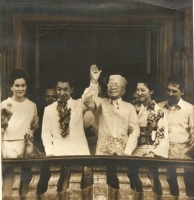
[L] The then His Imperial Highness Crown Prince Akihito and Princess Michiko with General Emilio Aguinaldo at the balcony of the National Independence Shrine in Cavite ©National Independence Shrine
The Imperial Family’s visits have helped in deepening our bonds. The then His Imperial Highness Crown Prince Akihito and Princess Michiko paid their maiden visit to the Philippines in 1962, even meeting General Emilio Aguinaldo. 54 years later, in 2016, His Majesty the Emperor Akihito and Her Majesty the Empress Michiko returned to the Philippines for their historic visit for the 60th Anniversary of our friendship — reaffirming the strong foundation of our heightened ties.
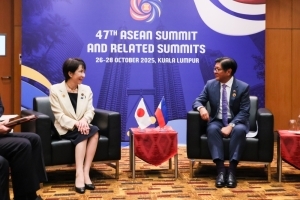
[L] Prime Minister TAKAICHI Sanae with President Ferdinand Marcos Jr. during the Japan-Philippines Summit Meeting in Malaysia © Cabinet Public Affairs Office
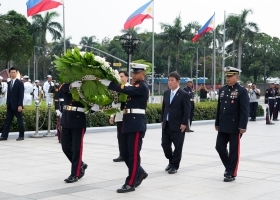
[R] Foreign Minister MOTEGI Toshimitsu offers flowers at Rizal Park during his visit in January 2026
In the last seven decades, there have been countless exchanges at various levels, each of which helped lead to our shared mutual understanding. Fast forward to the present, Prime Minister Takaichi Sanae’s first face-to-face meeting with a foreign leader after her inauguration was with President Ferdinand R. Marcos Jr. in October 2025. In January 2026, Foreign Minister Motegi Toshimitsu visited the Philippines as part of his first bilateral overseas tour. These developments underscore the high priority that Japan places on the Philippines as a close neighbor and trusted strategic partner who shares fundamental values and principles.
Fortifying ties as partners in progress
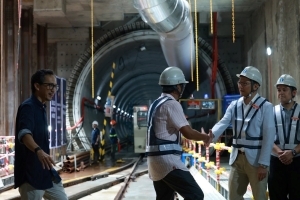
[L] Visit of President Ferdinand Marcos, Jr. in the Metro Manila Subway Project with DOTR Secretary Vince Dizon ©JICA
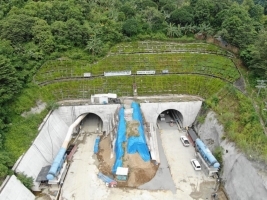
[M] Twin Tunnels of Davao Bypass Road - the tunnel breakthrough is now the longest mountain tunnel in the Philippines at 2.3 kilometers ©JICA
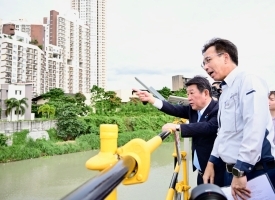
[R] Foreign Minister MOTEGI Toshimitsu inspects the progress of the Pasig-Marikina River Channel Improvement Project in January 2026
Our economic partnership is another important thread in this tapestry of friendship. Since the 1960s, Japan has supported the Philippines through Official Development Assistance (ODA), contributing to progress in vital areas such as disaster risk reduction and infrastructure development. This commitment continues today through landmark projects including the Metro Manila Subway Project (MMSP), the North-South Commuter Railway (NSCR), the Davao City Bypass, and the Pasig-Marikina River Channel Improvement Project.
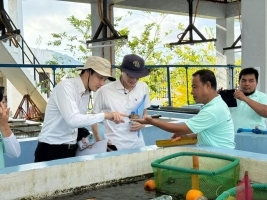
[L] Empowering BARMM fisherfolk through the project “Development of a Sustainable Fishery Value Chain in the BARMM” with the Food and Agriculture Organization (FAO)
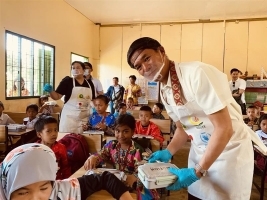
[M] Ambassador Endo serves meals to beneficiaries of the “The Project for the Promotion of ‘Farm-to-School’ Meals Programme Using Locally Harvested Products in BARMM” implemented by the World Food Programme (WFP)
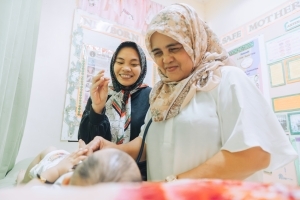
[R] Maternal and Child Health and Nutrition Improvement in Bangsamoro Region ©JICA
[M] Ambassador Endo serves meals to beneficiaries of the “The Project for the Promotion of ‘Farm-to-School’ Meals Programme Using Locally Harvested Products in BARMM” implemented by the World Food Programme (WFP)
[R] Maternal and Child Health and Nutrition Improvement in Bangsamoro Region ©JICA
On the Bangsamoro Autonomous Region in Muslim Mindanao’s (BARMM) path toward peace, development, and self-reliance, Japan has stood steadily alongside the region. Japan remains committed to advancing peace through dialogue and translating peace into tangible dividends through development.
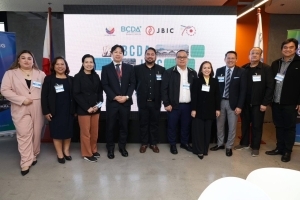
[L] Group photo of presenters at BCDA & JBIC PROJECT PITCHING EVENT & management team of JBIC and BCDA ©JBIC
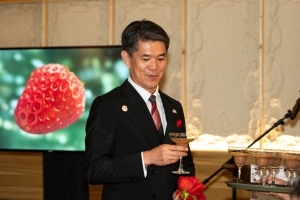
[R] Japanese strawberries, approved for export to the Philippines in December 2024 and first imported in February 2025 © JETRO
Japan-Philippines business collaborations continue to flourish. In 2025, Japan was the second largest trading partner and the largest investor for the Philippines. Around 1,600 Japanese companies are operating their businesses in the country.
Advancing peace and security through cooperation
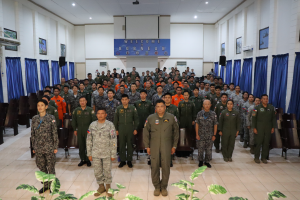
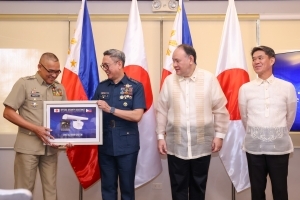
[L] Japan and the Philippines facilitate humanitarian support and disaster relief exercises at the DOSHIN BAYANIHAN 5-25 following the RAA implementation © Philippine Air Force
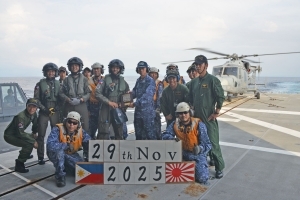
[M] Japan Maritime Self-Defense Force (JMSDF) and the Philippine Navy (PN) conduct the 3rd Bilateral Maritime Cooperative Activity (MCA)
[R] Handover ceremony of the five coastal radar systems to the Philippines under Japan's Official Security Assistance (OSA) FY 2023 © Department of National Defense
Our security cooperation has likewise evolved in ways that contribute to peace and stability, in line with the vision of a Free and Open Indo-Pacific (FOIP). The Japan-Philippines Reciprocal Access Agreement (RAA), which entered into force in 2025, has facilitated joint humanitarian assistance and disaster relief exercises, demonstrating how interoperability can translate into tangible support for disaster response and resilience-building.
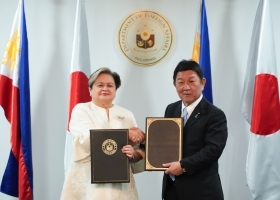
Foreign Minister MOTEGI Toshimitsu and Department of Foreign Affairs (DFA) Secretary Maria Theresa Lazaro sign and exchange notes for the JPY 900 million “Official Security Assistance (OSA)” FY2025 project
The Official Security Assistance (OSA) program is another important pillar of our cooperation, aimed at enhancing resilience by strengthening the Philippines’ defense capabilities through the provision of essential equipment and capacity-building. Notably, the Philippines is Japan’s only partner to have received OSA for 3 consecutive years. Just this February 11, I attended a handover ceremony for 5 coastal surveillance radar systems, as part of the first OSA project, with Department of National Defense Secretary Gilberto Teodoro Jr.
Japan and the Philippines work closely in multilateral fora to promote peace and prosperity in the region and beyond. We take pride in our long-standing partnership in advancing nuclear disarmament and non-proliferation, guided by our shared aspiration for “a world free of nuclear weapons.” We are also working hand in hand to address global challenges such as climate change through initiatives like the Asia Zero Emission Community (AZEC), and to advance development cooperation through frameworks such as the Conference on cooperation among East Asian countries for Palestinian Development (CEAPAD). As the Philippines assumes its important and responsible role as ASEAN Chair this year, Japan will spare no effort in extending its cooperation.
Binding our ties through cultural exchange
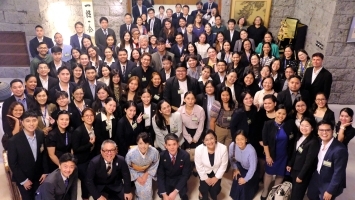
[L] Japan Exchange and Teaching (JET) Programme Fellowship Reception at the Ambassador’s Residence
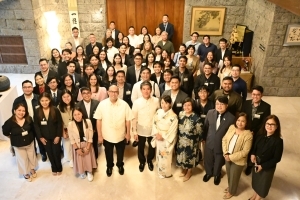
[R] Send-off Reception for the 2025 Japanese Government (MEXT) Scholars
Beyond policies and programs, the most enduring strands of our friendship are woven by people — through educational exchanges, cultural interaction, academic cooperation, and everyday friendships. In 2025, 73 Filipino scholars were supported under the MEXT Scholarship Program, and Japan welcomed its first participant from the Philippines in the Young Leaders Program in the field of Healthcare Administration. That same year, 67 young Filipinos embarked on enriching experiences under the Japan Exchange and Teaching (JET) Programme.
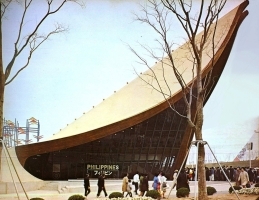

[L] The Philippine Pavilion at the Osaka Expo 1970, designed by architect Leandro Locsin© PhilStar.com
[R] Philippine Pavilion at the Expo 2025 featuring 200 handwoven textiles representing the Philippines’ 18 regions © Presidential Communications Office
The Osaka Expo 2025 also offered meaningful platforms for people-to-people exchange. Building on this proud legacy, the Philippine Pavilion at the 2025 Expo was awarded the prestigious Silver Award for outstanding design. We once again extend our heartfelt appreciation to the creative Filipino minds behind the pavilion for their contribution to the success of this global event.
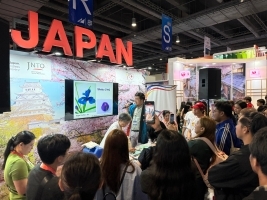
The Japan Pavilion, together with Japanese suppliers, at the Travel Tour Expo 2026 held at SMX ©JNTO
Travel, too, has served as a reliable bridge between our cultures. I am delighted to note that Japan welcomed more than 880,000 Filipino visitors in 2025 alone — an encouraging testament to the growing closeness between our peoples.
Weaving the future together
All these illustrate how the Japan–Philippines relationship has been shaped over time by many threads of cooperation and friendship. The work of weaving, however, does not end here. As we look ahead this 2026, I hope we can reflect on our future together and identify “new threads” to our growing partnership.
One such thread, in my view, lies in economic cooperation. For decades, Japan has been the leading development partner of the Philippines across a wide range of fields. As our economic ties continue to deepen, we hope to expand our cooperation into new frontiers, including digital and green transformation, space, and broader economic security.
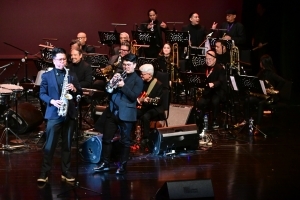


Harmony of Friendship: A Jazz Prelude to 70 Years of Japan-Philippine Ties, the opening event for the 70th Philippines-Japan Friendship Anniversary
From postwar reconciliation to a comprehensive partnership for peace and prosperity, the Philippines–Japan relationship is a tapestry woven from diplomacy, development, security, and, above all, human connection. As we embark on a year of commemorative events for our 70th anniversary, we warmly invite our Filipino friends and partners to join us in the celebrations, as we continue weaving our future together — toward peace, prosperity, and possibilities for generations to come.